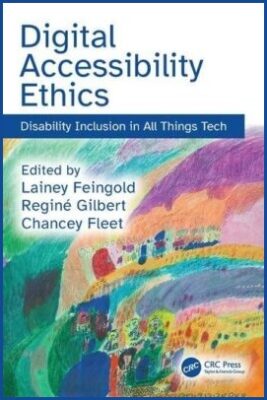
Welcome to the Discussion Guide for Digital Accessibility Ethics: Disability Inclusion in All Things Tech. The editors and authors invite you to read the book with colleagues, work teams, friends, community members, Meetups, or as part of an organizational offering. This resource is intended to help guide your discussion.
This resource has the following sections. Happy Reading!
share on linkedinshare on bluesky
Introduction
Digital Accessibility Ethics: Disability Inclusion in All Things Tech is an edited collection written by 39 authors from 10 countries and one commonwealth. Together we have over 600 years of accessibility and disability experience. The book introduces the first Digital Accessibility Ethics Framework, a values-driven actionable strategy with two goals: (1) advance digital accessibility across sectors and (2) help disabled people and organizations avoid the risks and harms of disability exclusion in tech.
You can learn more about the book on AccessibilityEthics.org, the ethics book website. There you will find the full table of contents, bios of all 39 authors (including 3 editors), testimonials from our early endorsers, and other resources.
This Discussion Guide can’t possibly cover all 32 chapters and 411 pages of the first book to offer a digital accessibility ethics lens to help advance disability inclusion in tech and avoid the harms of exclusion. If you want your book gathering to focus on one or two particular chapters, please let us know if you would like us to prepare specific discussion topics tailored to those chapters.
Remember that the topics and questions in the guide are suggestions only. We hope you find them helpful, while we know your own ideas, questions, and discussion topics are most important in guiding your group gathering.
[Note about images in this Guide: All images in this Discussion Guide appear in the digital accessibility ethics book. The image at the top of this guide is our book cover. It is illustrated with a painting by Ana Maria Vidalon is a Spanish‑speaking artist with a disability originally from Peru. The painting features arcs of yellow, orange, blue, turquoise, pink, and purple. The lower half of these swaths of bright colors are populated by diverse figures, circles, and building‑like shapes. Read more about the cover art at the beginning of the book.]
Discount for readers
Our publisher, Taylor & Francis, has generously offered a 30% discount off the price of the print and digital book purchased on their website for book groups of 5 or more readers. The book is also available on Bookshare and other libraries for people with print disabilities.
Please contact us at Info@AccessibilityEthics.org if you would like to take advantage of the publisher’s discount. You can also use that email to invite one or more of the book’s 3 editors and/or 39 authors to attend your book discussion.
Reading the digital accessibility ethics book in a group: a great idea
During the first three months after publication, authors and editors attended gatherings of people reading Digital Accessibility Ethics: Disability Inclusion in All Things Tech in a group setting. (Thank you to the Accessibility Book Club , the Durham-Raleigh Accessibility MeetUp, and the AliCE (The Alliance for Interdisciplinary Innovation in Computing Education (AliCE)) book club at the University of Washington DO-IT program. Groups had between one and four meetings to discuss the book.
Attending these group discussions gave us the idea to create this guide and encourage group reading. Thank you early group readers! If you read the book in a group (even a group of two!) let us know; it will help inspire others to do the same.
The group discussions we attended were varied, interesting, and authentic. Each participant brought their unique perspective to the Digital Accessibility Ethics Framework, and to the stories and strategies at the heart of the collection. Not all readers had finished the book, and some had not yet started, yet the conversations were still impactful.
Finishing the book is not required to be part of a book discussion!
As mentioned above, the book is written by 39 authors (including the 3 editors who also wrote chapters). We are both disabled and non-disabled and come from 10 countries and one commonwealth. Reading the book with others extends the global collaboration the book represents. Collective reading, like collective writing, can amplify ideas and expose unexpected themes.
Plus, reading in a group is fun!
Want to read the digital accessibility ethics book with others but don’t have a group? Let us know by sending us an email in Info@AccessibilityEthics.org. Depending on interest, the editors and authors may be hosting a book group meeting of our own. We may also be able to connect you with another group.
How to read the digital accessibility ethics book
Before publication, the authors and editors thought about how readers might engage with the book. On page 7 of the Introduction to Digital Accessibility Ethics: Disability Inclusion in All Things, the editors wrote:
Please read this book in the order your interests dictate. The most important advice we can give is to engage in all the chapters with open minded curiosity. As editors we learned so much from the authors about topics we never knew about, stories we never heard. We predict you will too.
A week before publication, Margaux Joffe, author of Chapter 8, Empower All Minds: Cognitive Accessibility Ethics, had another idea about how to read the book. Here’s what she posted on LinkedIn in April 2026:
Intimidated by a big book? I get it. As your ADHD friend I give you permission to not read the whole thing. (Gasp) Yes. Get a copy and read what is interesting and relevant to you. There are 32 chapters by 39 different authors. So much expertise in one place. In my brain it’s like a TV show with a big cast and all different storylines. (my favorite kind of show)
And now that she’s read the book, Margaux recently shared more thoughts about how to read the book:
As someone with ADHD, the short chapters and the variety of topics and authors make the book easy and interesting to read. You don’t have to read the whole entire book. Each chapter offers nuggets of wisdom and thought provoking perspectives.
Check out the Table of Contents to think about what chapters you want to read first!
Questions and topics for discussion
The discussion topics and questions below are presented in the way the book is organized. Digital Accessibility Ethics: Disability Inclusion in All Things Tech has an Introduction, a Conclusion, and 32 chapters organized into three sections.
Introduction and Section One: Foundation (pages 1-84)

The Introduction to the Digital Accessibility Ethics book lays out the big-picture reasons an ethics framework is needed. And needed now.
Section One (Foundation) includes 4 chapters: The Digital Accessibility Ethics Framework, the basics of disability and accessibility, the ethical dilemmas of artificial intelligence, and the global digital accessibility legal landscape.
Here are some questions and topics to spark conversation about this first part of the book:
- Do you think framing digital accessibility as an ethical issue can motivate organizations and individuals to make technology more accessible?
- Did learning about the ethics framework motivate you?
- What is the biggest challenge you anticipate in getting organizations to adopt the Digital Accessibility Ethics Framework?
- Why does the book say it is reclaiming “digital accessibility”? Do you agree that accessibility needs reframing?
- Were you surprised by anything you read about disability and accessibility in the foundational chapter on these topics?
The Digital Accessibility Ethics Values
Chapter One explains that the Digital Accessibility Ethics Framework is a three-part tool (or strategy) made up of values, actions, and questions. Here are the ten values identified in the first chapter:
- Inclusion and non-discrimination
- Equitable experiences
- Privacy, confidentiality, and security
- Agency, autonomy, and self-determination
- Honesty, transparency, trust, and accountability
- Avoiding harm and reducing risk
- Fairness
- Legal compliance
- Awareness and education
- Sustainability
When you think about these values,
- Which values resonated most with you and why?
- Are there values you think should have been included? Not included?
- Which values do you think will be most useful to you in introducing an ethics lens to your work or community?
Digital Accessibility Ethics Questions and Actions
The Digital Accessibility Ethics Framework also includes actions and questions. Pages 22 – 31 list sample actions for each value. Chapter authors identify other actions throughout the book based on the topics they write about.
All 150+ actions and questions listed in the book are examples only. Additional actions and questions will be determined by every individual and organization applying the Digital Accessibility Ethics Framework.
Questions are designed to disrupt exclusion and set us on the path of inclusion. The questions invite us all to PAUSE before we make decisions about technology and digital content. To PAUSE and adjust our course toward one of inclusion. To PAUSE and ask more questions.
Questions like “what assumptions are we making about who will use this product or read this digital content?” Or “Who might be excluded if we make this decision? Do we know enough about how disabled people use tech to answer this question?”
- What two questions do you wish were asked more often in your workplace that would lead to more accessible products and services?
- Do you see an opportunity to use the “power of the pause” in your personal or professional life to bring the digital accessibility ethics values into your relationship with technology?
Actions are an essential part of the Digital Accessibility Ethics Framework. Actions such as “giving employees time and budget to learn about different ways disabled people will use the technology our organization is building, buying, or selling.” Or “provide a robust feedback loop to capture, remediate, and report back on accessibility gaps identified by disabled people and others.”
Framework actions have the potential to bring the Digital Accessibility Ethics Values into all aspects of designing, building, and maintaining all things tech.
- What is one action you could take in the next two months to bring the values of the Digital Accessibility Ethics Framework into your personal or professional life?
- Share an action you or your organization are already doing to make technology more accessible. What digital accessibility ethics values are reflected in that action?
The risks of disability exclusion in tech
The digital accessibility ethics framework is about advancing accessibility and avoiding risks and harms. The Foundation Section identifies risks and harms to disabled people, organizations, and society at large that can occur when digital accessibility is ignored:
- Legal risk
- Reputational risk
- Risks and harms to health and safety
- Risk and harms to democracy
- Risks and harms to mental health
- Risks to employee productivity, and
- Systemic risks
Thinking about these risks:
- How could you use the Digital Accessibility Ethics Framework as a risk and harm prevention strategy in your work or community?
- Have you had direct experience with any of these risks and harms?
- Are there any risks or harms you think the editors should have included?
Other topics for discussion about the Foundation Section

- Why is it relevant to digital accessibility ethics that a growing number of countries around the globe have accessibility laws or regulations?
- What role could the Digital Accessibility Ethics Framework play in assisting advocates seeking new accessibility laws and regulations in their countries?
- The foundational artificial intelligence chapter talks about the risks and opportunities of AI.
- What is one thing you learned from the chapter that you didn’t know before?
- Have you experienced either the risks or the harms of AI? Have you experienced both?
- How might you use the ideas in the artificial intelligence chapter to advocate for more ethical use of AI in your workplace or institution?
- The US may have too many lawsuits pushing for digital accessibility. But other countries like Japan or Ethiopia have no lawsuits, and no effective laws. What do you think the role of the law is in advancing accessibility?
- What ideas from pages 1 – 84 might influence how you approach and make decisions about digital accessibility moving forward? What will you (try) to do differently?
Section 2: Ethical Accessibility Practices (pages 85-260)
Section 2 of the book is about how to do accessibility work ethically. It has 14 chapters on topics ranging from design and development to procurement, hackathons, overlays, and accessibility practitioner burnout.
All the chapters in this section end with Digital Accessibility Ethics Takeaways. The Takeaways identify the values, actions, and questions of the Digital Accessibility Ethics Framework the author(s) found most relevant to their chapter.
The last takeaway in every chapter is “Reader Reflections: What actions, questions, or other reflections could you bring to your work and community about the topic of this chapter.”
- Was the invitation to reflect on how you could use chapter and Takeaway ideas in your own work helpful to you? Are there any reflections from the chapters in Section 2 that you would like to share?
Discussion topics for specific Section 2 chapters
Due to space constraints, this Reader’s Guide touches on only some of the chapters in Section 2. This is of course no reflection on the importance of any chapter. If you would like discussion topic ideas for any Section 2 chapter not mentioned, please let us know!
- The author of Chapter 10 about hackathons and capstone projects discusses the overlaps and distinctions between lived disability experience, disability experts, and accessibility experts. Does this framing resonate with you? How could you use this idea in your work?
- Chapter 9 is titled “Don’t Buy Broken Things: Ethical Accessible Procurement”
- How could identifying inaccessible technology as “broken” impact your advocacy in advancing accessibility?
- How might this chapter change how you buy products and/or services to improve accessibility and remove harms?
- Chapter 14 includes a section titled “Describing Race and Other Identities.” The authors write that “excluding color, race, or other identities such as gender and disability from description limits accessibility for Blind people by obscuring what obvious to visual viewers.”
- How might this chapter change your own practices of describing (or not describing) images at work or with your social media accounts?
- Chapter 18 is titled Accessibility Practitioner Burnout is an Ethics Issue.”
- Why is burnout an ethics issue?
- If you have every experienced burnout, do the ideas in this chapter resonate with you?
- How could applying the Digital Accessibility Ethics Framework help organizations protect against burnout of accessibility workers?
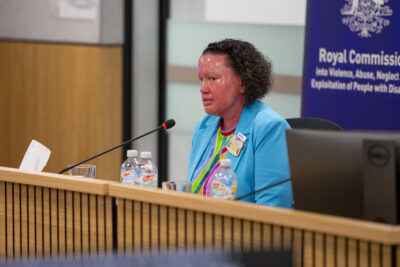
- Many of the chapters in Section 2 include stories of the impact of inaccessibility on the author’s personal lives. (An example is Chapter 15, written by Carly Findlay, who included the image accompanying this section in her chapter.)
- How did these personal stories affect your understanding of the digital accessibility ethics issues in the chapter?
- How could you use your own disability story, or the stories in the book, to advocate for more ethical accessibility practices?
- What ideas from pages 85 – 260 might influence how you approach and make decisions about digital accessibility moving forward?
Section 3: Digital Accessibility Ethics Across Sectors (pages 261-407)

Section 3 of the book is titled Digital Accessibility Across Sectors. In its 14 chapters, authors share why, in a digital world, digital accessibility and the ethics framework must be part of ethics for any activity with a digital component.
Due to space constraints, this Reader’s Guide touches on only some of the chapters in Section 3. This is of course no reflection on the importance of any chapter. If you would like discussion topic ideas for any Section 3 chapter not mentioned, please let us know!
Discussion topics for specific Section 3 chapters
- Section 3 generally: Digital Accessibility Ethics identifies 14 sectors that need digital accessibility to make their own work ethical. Sectors like healthcare, gaming, robots, and publishing.
- What sectors, if any, do you think need digital accessibility that were not covered in the book?
- How could the values, actions and questions of the Digital Accessibility Ethics Framework apply in those sectors?
- Chapter 19 (emergency preparedness) The author uses the ethics value of “avoiding harm and reducing risk” as a lens to make emergency preparedness more accessible.
- The author of this chapter identifies four phases of emergency planning: preparedness, response, relief, and recovery. Have you been impacted by accessibility or the lack of accessibility in any of these phases?
- What harms and risks are present when digital accessibility is not built in to emergency systems?
- Are you in a position to improve the accessibility of emergency planning? How could the Digital Accessibility Ethics Framework help you in your work?
- Chapter 20 (robots and new technologies), Chapter 28 (immersive technologies) and Chapter 24 (tech facilitated disability discrimination and AI workplace tools) talk about technologies that barely existed 10 years ago.
- Imagine a technology that doesn’t fully exist yet (scheduling time travel? Rollout of the Interplanetary Internet?)
- What risks and harms to disabled people might occur in the roll-out of your imagined technology if accessibility is not implemented?
- How might the Digital Accessibility Ethics Framework help ensure that disabled people aren’t left out of what you are imagining?
- Chapter 21 (cybersecurity):
- Have you ever been unable to use a CAPTCHA on a website? (A CAPTCHA asks you to identify numbers, letters, or pictures before you can continue on the site.)
- If yes, how did that make you feel?
- How could you use your personal story when talking about the need to apply the Digital Accessibility Ethics Framework to decisions about privacy and security in tech?
- Chapter 32 (legal ethics and access to justice):
- Have you ever been impacted by the lack of accessibility in any part of the legal system?
- If yes, can you see a role for the Digital Accessibility Ethics Framework to improve accessibility in the legal system?
- What does access to justice mean to you? How might applying the Digital Accessibility Ethics Framework to decisions about legal tech improve access to justice
- How could applying the Digital Accessibility Ethics Framework make the use of AI in legal spaces more ethical?
- Check out the Digital Accessibility Ethics for the Legal Profession resource for more ideas about why the book is an important read for lawyers, law students, legal workers and others.
- What ideas from pages 261-407 might influence how you approach and make decisions about digital accessibility moving forward?
Conclusion (pages 408-411)
The Conclusion to Digital Accessibility Ethics: Disability Inclusion in All Things Tech asks a question to all of us:
“What’s Next for Digital Accessibility Ethics?
On page 409-410 we list 10 ideas to help spread the word, and to help you become a digital accessibility ethics innovator, including using our hashtag, #DigitalAccessibilityEthics in social media posts about accessibility.
The goal of all the ideas? To bring ethics into conversations about accessibility and technology and turn those conversations into meaningful questions and impactful actions.
- What is one conversation you could have with someone in the next 30 days that could help spread the Digital Accessibility Ethics Framework and its values, actions, and questions.
- What is one thing you can do in the next 3 months to start incorporating the Digital Accessibility Ethics Framework into your work, community, or personal use of technology?
- How could the Digital Accessibility Ethics Framework and the stories and strategies in the book influence your work going forward?
- Who do you know who could benefit from this book, or from reading the book in a group, and what could you do to encourage that?
As we write in the last page of the Conclusion,
Our dreams for this book are broad and deep, and it will take all of us to make them a reality. We encourage you to ask yourself: What role can I play? What role can my organization play? How can we contribute to a world where ethical digital accessibility is integral to disability inclusion in all things tech? Digital Accessibility Ethics: Disability Inclusion in All Things Tech, page 411
Thank you for being part of this effort.
Please send us your feedback!
We want this guide to be helpful to all readers. Please send all feedback to us at Info@AccessibilityEthics.org.
- What is missing from this Discussion guide?
- What worked for your group?
- What didn’t work? What topics were were most engaging?
- What else would you like us to know about your experience reading the digital accessibility ethics book in a group?
We look forward to hearing from you!
Back to top