Introduction
Digital accessibility is about more than meeting technical standards. It is about the choices we make and their impact on disabled people. Will they cause harm or protect privacy, safety, and human rights? Will they lead to inclusion or will they lock people out?
The Digital Accessibility Ethics Framework is a values-driven actionable strategy to disrupt patterns of disability exclusion in tech. It has two goals: (1) advance digital accessibility across sectors and (2) help disabled people and organizations avoid the risks and harms of disability exclusion in tech. It is introduced and explored in a groundbreaking book titled Digital Accessibility Ethics: Disability Inclusion in All Things Tech. 39 authors from 10 countries and one commonwealth apply the Framework through stories, strategies, and recommendations across sectors and technologies.
The Framework has three parts:
Values — to guide decisions
Actions — to put values into practice
Questions — to prompt reflection and ethical decision-making
The Framework is flexible. It can (and should) evolve as technology, laws, standards, and the expectations of disabled people change.
The Digital Accessibility Ethics Framework is a dynamic roadmap leading to a more ethical and disability-inclusive digital world.
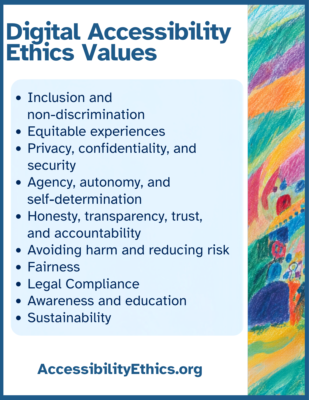
Digital Accessibility Ethics Values
These are the values that lie at the heart of digital accessibility ethics.
- Inclusion and non-discrimination
- Equitable experiences
- Privacy, confidentiality, and security
- Agency, autonomy, and self-determination
- Honesty, transparency, trust, and accountability
- Avoiding harm and reducing risk
- Fairness
- Legal compliance
- Awareness and education
- Sustainability
Digital Accessibility Ethics Actions and Questions
Actions and questions are the second and third prongs of the Digital Accessibility Ethics Framework. They take the values off the page to make digital accessibility ethics an actional strategy for a disability inclusive digital world.
Actions
Actions are an essential part of the Digital Accessibility Ethics Framework.
Actions such as
- Give employees time and budget to learn about different ways disabled people will use the technology our organization is building, buying, or selling.
- Provide a robust feedback loop to capture, remediate, and report back on accessibility gaps identified by disabled people and others.
- Don’t publish visual content without robust, accurate, and culturally competent description.
Actions have the potential to bring the Ethics Values into every aspect of designing, building, and maintaining all things tech.
Questions
Digital Accessibility Ethics Questions are designed to disrupt exclusion and set us on the path of ethical inclusion. The questions invite us all to PAUSE before we make decisions about technology and digital content. To PAUSE and adjust our course toward one of inclusion, away from risk and harm. To PAUSE and ask more questions.
Questions such as
-
- What assumptions are we making about who will use this product or read this digital content?
- Who might be excluded if we make this decision?
- Do we know enough about how disabled people use tech to answer this question?
Digital Accessibility Ethics: Disability Inclusion in All Things Tech lists more than 150 actions and questions infused with the digital accessibility ethics Values. These are examples only. Additional actions and questions will be determined by every individual and organization using the Digital Accessibility Ethics Framework.
Order the Book
To receive a 30% discount on the purchase the book, go to the publisher’s book page (found at Routledge.com, search for Digital Accessibility Ethics). Add the digital or paperback format to the shopping cart. Once in the cart select “Add a promo code” and enter the Discount Code DAE2026 to access the discount.