
Introduction
Digital Accessibility Ethics: Disability Inclusion in All Things Tech is an edited collection written by 39 authors from 10 countries with over 600 years of accessibility and disability experience. It introduces the first Digital Accessibility Ethics Framework, a values-driven actionable strategy with two goals: (1) advance digital accessibility across sectors and (2) help avoid the risks and harms to disabled people and organizations of disability exclusion in tech.
This book is a must read for publishers, librarians, and anyone in the business of content production.
Why?
In a world where factual and accurate information is a fundamental necessity, digital accessibility determines who gets to participate in society. The ability to read news, access educational or professional content and literature, and engage with public discourse should be the same for everyone, regardless of ability. Yet millions of people with disabilities face obstacles to basic access due to continuing barriers in digital publishing.
- The right to information belongs to everyone. It is the responsibility of authors, publishers, and journalists to ensure no one is left behind.
- Digital accessibility belongs in all publishing ethics codes.
- Fairness is the central ethics value. The exclusion of disabled people from information is not a matter of inconvenience, it is an ethical failure.
- The decision not to provide accessible content has real-life consequences and leads to tangible harm in the short- and long-term.
- The issue of misinformation and trustworthiness is key in today’s digital environment. Verifying the credibility of a source is even more challenging (or even impossible) when access is limited.
- Digital platforms can act as gatekeepers, limiting access to critical information.
- Short-cuts in content creation can result in the exclusion of people with disabilities from education leading to long-term harmful impacts.
- Using an ethical lens in publishing means paying attention to the technical debt publishing tools create, and its aftereffects throughout the supply chain — into reading systems, vendor sites, and libraries.
- Accessible collection development is not only a publishing issue but a library issue. Equitable access to information is a critical library role. Collections that exclude disabled readers fall short of that, regardless of what publishers produce.
- Libraries are also purchasers of digital platforms and content, not just distributors of what publishers produce. Procurement decisions carry real weight, and libraries have a responsibility to ask accessibility questions before signing licences or contracts, not after.
- Libraries looking to put these principles into practice can find companion resources at accessiblelibraries.ca. Relevant resources include:
- a guide to accessibility considerations in the procurement of licensed digital resources, including accessible digital books,
- guidance on building #OwnVoices collections representing disabled authors and creators, and;
- plain-language explanations of assistive technology for library staff who are new to the topic.
Sample Chapters for Publishers and Librarians
Below is a sampling of just some of the chapters with crucial information for publishers and librarians. Find the full table of contents here. Information about all authors and editors can be found here.
- Who Gets to Read, Who Gets to Publish? Digital Accessibility Ethics for Authors, Journalists, and Publishers (Chapter 25 by Laura Brady and Daniella Levy-Pinto)
- Introducing the Digital Accessibility Ethics Framework (Chapter 1 by the editors)
- Designing With: Widening Power and Participation of Disabled People in the Design Process (Chapter 5 by Josh Kim)
- Empower All Minds: Cognitive Accessibility Ethics (Chapter 8 by Margaux Joffe)
- No One Left Behind: Digital Accessibility Ethics and Emergency Preparedness (Chapter 19 by Erin E. Brown)
- Digital Accessibility and Digital Amenities (Chapter 31 by Chancey Fleet)
Where to find Digital Accessibility Ethics: Disability Inclusion in All Things Tech
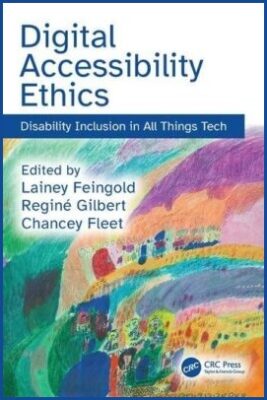
- The book is available in print and digital formats through Amazon and other book-selling platforms across the globe. The audio book is underway.
- CRC Press, part of the Taylor & Francis Group, is the publisher of Digital Accessibility Ethics: Disability Inclusion in All Things Tech. You can find the book on the publisher’s website here.
- The book is available in Bookshare and other libraries for people with print disabilities.
- It is also available at NNELS, the Canadian National Network for Equitable Library Services.
- Your library? We’d love to see the digital accessibility ethics book in law, university, and public libraries.
Want to read the book in a group?
- Reading Digital Accessibility Ethics: Disability Inclusion in All Things Tech in a group setting extends the global collaboration of its 39 authors.
- In the first three months since publication, the editors and authors have been invited to 3 book groups. Reading with others sparked great conversation and created moments of unexpected connection.
- The publisher offers a discounted price for groups of 5 or more who want to read the book together.
- Read our Ethics Book Discussion Guide for information and topics for reading the book in a group.
Want to learn more?
- Check out other part of the book’s website at AccessibilityEthics.org
- Authors and editors are available for talks, trainings, webinars, podcasts, conferences and other gatherings. Visit the Events Page to read about past and upcoming talks. Reach out to us by email at Info [at] AccessibilityEthics [dot] org to explore different ways your organization can learn more about Digital Accessibility Ethics: Disability Inclusion in All Things Tech.
Image at the top of this Resource
Images in Digital Accessibility Ethics: Disability Inclusion in All Things Tech enhance the content in many chapters. At the top of this Resource is an image from Chapter 25, Who Gets to Read, Who Gets to Publish? Digital Accessibility Ethics for Authors, Journalists, and Publishers; Laura Brady and Daniella Levy-Pinto.
The image is of Captain Ian Fraser listening to a talking book on phonograph disk. The first ‘talking books’ were created for veterans who had lost their sight in WWI. The idea was originated by Captain Fraser, who was blind due to injuries sustained at the Battle of the Somme, and became frustrated by how slowly he was able to read braille.
With help from the Royal National Institute of Blind People (RNIB), Fraser’s team opened their first recording studio in 1934, and began distributing spoken novels in 1935. For more about Ian Fraser, see the Westminster Abbey commemoration for Lord Fraser of Lonsdale. (Credit: Blind Veterans UK.)