At the 2026 M-Enabing Summit earlier this month, Lainey delivered a 15 minute lightning talk on the main stage about digital accessibility ethics.
The annual Summit is a global leadership conference dedicated to policies and best practices about digital accessibility, assistive technology, and inclusive design. Two days of keynotes, lightning talks, expert panels, sessions and seminars focus on helping organizations embed accessibility into their culture, operations, and digital initiatives.
I was so glad to be a part of it. Yet sharing the essence of our book, Digital Accessibility Ethics: Disability Inclusion in All Things Tech, in 15 minutes — with its 39 authors, 32 chapters, and 400+ pages — was no easy feat.
My speedy talk is below. Let me know what you think.
share on linkedinshare on bluesky
Lightening Talk: Digital accessibility is an ethical imperative
[Note: The headings in this article make the written text clearer and were not part of the talk. The talk below was lightly edited and may not match exactly what I said on the stage.]
Early reference to accessibility in United States law
Thirty years ago, in September 1996, US Senator Tom Harkin wrote to the US Department of Justice (DOJ). It was 6 years after the Americans with Disabilities Act (ADA) was passed and Senator Harkin had been instrumental in its passage.
What is the government’s policy,” the Senator asked, on making web pages compatible for the disabled?Senator Harkin to DOJ
The DOJ wrote back:
If organizations covered by the ADA, whether they are public and private, use the Internet for communications about their programs, goods, and services, they:
Must be prepared to offer those communications through accessible means as well. DOJ lawyer Deval Patrick answering Senator Harkin’s question
As far as I know this is the first reference to digital accessibility being part of the Americans with Disabilities Act.
30 years of digital accessibility legal developments around the world
In the 30 years since then, there have been many many legal developments toward greater accessibility:
- The year 2000 saw the world’s first lawsuit about web accessibility barriers, in Australia. The case was brought by a blind woman who couldn’t access the website of the Sydney Olympics that year.
- Also that year — 26 years ago — the first web accessibility settlement was reached here in the US. I helped negotiate that agreement between Bank of America and some of its blind customers about the bank’s online banking system. When less than 4% of the public was banking on line, I’m forever grateful that the blind leaders I was working with recognized the importance of accessibility in the financial sector.
- In 2006 The United Nations Convention on the Rights of Persons with Disabilities (UNCRPD) was adopted by the United Nations General Assembly. It spurred laws across the globe and offers us all a blueprint for a truly disability inclusive, accessible society. Honestly, if you’ve never read the CRPD I highly recommend it.
- And more recently, in the last 4 years:
- Kenya adopted first accessibility standards in Africa
- Canada adopted the first standard in the world for Accessible and Equitable Artificial Intelligence Systems
- Laws incorporating the European Accessibility Act became effective in all 27 European Union countries
- Iceland passed its very first digital accessibility law when it incorporated the Web Accessibility Directive into Icelandic law.
- The Supreme Court of India ruled that the right to Digital Access is an intrinsic component of the right to life and personal liberty under the Indian Constitution.The ruling came in a case brought by blind people and victims of acid attacks who couldn’t use the digital verifications process on financial mobile apps across India.Why not?The app required blinking to prove you were a person. The Indian Supreme Court knew – human beings who can’t blink need access too.
We’ve come a long way – and not just with legal developments
Clearly we’ve come a long way in the past 30 years.
The examples I shared above are just a fraction of the ever-growing number of countries across the globe that have laws, standards, and regulations mandating accessibility in our ever-growing digital world.
And of course new legal developments aren’t the only accessibility advances of the past 30 years.
- We now have accessibility teams, Chief Accessibility Officers and accessibility champions.
- Thousands of certified accessibility professionals work across the globe. Hundreds of NGOs are dedicated to a digital world that works for all of us.
- We heard yesterday about impressive accessibility initiatives from some of the world’s largest companies. And a shout out to the many champions I know who are toiling alone in much smaller organizations.
- We have blog posts, conferences, websites, podcasts, trainings, and webinars.
- There are days and months to celebrate accessibility
- And over the past 30 years we’ve layered an industry on top of a global community that I am so grateful to be part of.
Are we finished?
We’ve made all this progress, Yet still….
- Who thinks the work is finished?
- Who agrees with me that we still have an unacceptable gap separating too many disabled people from too much technology and digital content?
This is this gap – the Digital Accessibility Gap – that the Digital Accessibility Ethics Framework is designed to help close.
Introducing the Digital Accessibility Ethics Framework
The Digital Accessibility Ethics Framework was introduced this past Spring in a new book titled Digital Accessibility Ethics: Disability Inclusion in All Things Tech.
- The book was written by 39 authors from 10 countries and one commonwealth, a little over half of whom are disabled. Some of these authors are in the room today [Authors show themselves and I call out their names: Sheri Byrne-Haber, Monica Duhem, Shilpi Kapoor, Josh Kim, Irene Mbari-Kirika, Kate Sonka, Léonie Watson.]
- I’m one of three editors, and I also wrote two chapters about legal issues in the book.
- The best part of my chapters for me was interviewing lawyers and other people who know the law from Ethiopia, Japan, Canada, Kenya, Sweden, the United States and India.
For years I’ve said digital accessibility is global. Now I know digital accessibility ethics are too.
Framework goals and elements
The Digital Accessibility Ethics Framework is a values-driven actionable strategy to disrupt patterns of disability exclusion in tech.
Because yes, they are patterns of exclusion, not random one-offs.
The Digital Accessibility Framework has two goals:
- to advance ethical, sustainable digital accessibility across sectors and
- to help disabled people and organizations avoid the risks and harms of disability exclusion in tech. Not just legal risk we’re all too familiar with, but also reputational, health and safety, risks to democracy, systems risk.
The Framework has three parts in service to those goals: Values, Actions, and Questions
Digital Accessibility Ethics Values
The first prong of the Framework is Values. The Digital Accessibility Ethics Framework identifies ten values
- privacy confidentiality and security (3 words one value)
- fairness
- non-discrimination
- sustainability
- avoiding risk and harm
- awareness and education
- agency, autonomy, and self-determination
- equitable experiences
- honesty, transparency, trust, and accountability
- legal compliance
These values aren’t theoretical.
For example, when we design or purchase payment systems, security systems, or health care portals that cannot be independently used by people who can’t see a screen, hold a mouse, or have other disabilities, here’s what happens:
- people are forced to share sensitive financial, medical, or other personal information to perform basic digital tasks.
- Disabled people are harmed and the confidentiality of their personal information is sacrificed.
- Organizational security is broken and at risk.
- The Ethics Values of privacy, confidentiality, and security; equitable experiences; and autonomy are all ignored.
These are already our values
I think most of us in this room already hold and try to live by the values in the Digital Accessibility Ethics Framework. I think we already are guided by a values-driven approach.
The Digital Accessibility Ethics Framework gives a name and a structure to what we already know. The Framework makes it easier for us to share those values with others.
The Digital Accessibility Ethics Framework offers us a strategy
I say strategy because the Digital Accessibility Ethics Framework is more than values.
Digital Accessibility Ethics Questions and Actions
The other two parts of this 3-part strategy are
- the ACTIONS that bring these values to life,
- and the QUESTIONS that help incorporate the values into our work.
The Questions aspect of the framework ask us to pause at critical decision points and ask things like:
- What assumptions am I making about who will read this content?
- How will someone with a speech disability use this voice-to-text solution?
- Who will be excluded if I decide to take this shortcut?
- And do I even know?
We call this part of the Framework
The power of the pause – an opportunity to think about how our decisions in tech can either support or ignore the values we know are essential.
The questions help us take the actions that come down on the side of those values.
Applying the Framework
In the digital accessibility ethics book our 39 authors apply the Framework through stories, strategies, best practices and recommendations across sectors and technologies.
They do this in two categories:
First, how can we do OUR work, accessibility work, with ethics
- The 14 chapters in this section of the book address topics like the ethics of design, development, accessibility hackathons, accessible procurement, overlays and accessibility leadership and education
Second, how can we convince everyone else to incorporate digital accessibility into their ethics. Every field has ethics – too often disability and accessibility are left out.
- Authors in this section write about the need for digital accessibility ethics in cybersecurity, gaming, smart cities, AI employment tools, robots, healthcare, and more.
A foundation section at the beginning of the book offers a lens with which to read both these sections. The foundation’s four chapters are about the basics of accessibility and disability, the global legal landscape, the ethical dilemmas of artificial intelligence, and a deep dive into the values, actions, and questions of the Digital Accessibility Ethics Framework.
What about legal compliance?
I wrote two chapters in the digital accessibility ethics book about the law because I’ve been a digital accessibility-focused lawyers for the past 30 years. One offers an overview of the global digital accessibility legal landscape. The other is about why digital accessibility is essential to lawyer ethics and access to justice.
Honestly, some unethical things I’ve seen in the legal space in the past 10 years are part of the spark that got me thinking about how ethics fits into the work we all do.
For 30 years the law has been crucial to advancing digital accessibility. And it will continue to be so.
Law is also part of the Digital Accessibility Ethics Framework.
- Legal compliance is woven into the Digital Accessibility Ethics Framework. It is one of the 10 ethics Values.
- Our value-driven actions must include complying with the law.
- Our digital accessibility ethics questions must dive deep to ensure we understand and fulfill legal requirements.
But Legal Compliance is not the only value. Because it’s not enough to build the world we hunger for.
Despite the emphasis on legal compliance, the digital accessibility gap is still here. It is still unacceptable.
In my experience when our accessibility work is primarily driven by legal compliance we won’t have a sustainable, robust, ethical accessibility program.
Instead, when our advocacy and our motivations are only focused on the law:
- We have checklist accessibility
- We think our job is done on the day certain testing shows compliance. We forget that just as accessibility can be built, it can easily be broken.
- Most important — We forget that accessibility is about disabled people, yet
Disabled people are the heart of the Digital Accessibility Ethics Framework
So what can we do?
In the Conclusion of the digital accessibility ethics book we write that “Our dreams for this book are broad and deep, and it will take all of us to make them a reality.
So what can we all do?
- Let’s put ALL the values, actions, and questions of the Digital Accessibility Ethics Framework in our toolbox. Let’s put those values alongside the business case and the legal case
- Let’s use the the Digital Accessibility Ethics Framework to talk about the Accessibility WHY that was emphasized in yesterday morning’s plenary.
Why accessibility?
- Without it disabled people are excluded.
- Privacy and security are shattered.
- Autonomy is sacrificed.
- Because we value fairness.
- Because we don’t discriminate.
Why accessibility?
- Because it’s the ethical thing to do
- Because accessibility is an ethical imperative.
YES – let’s use the word ethics. Knowing it isn’t a buzz word but a word that embraces the values, actions, and questions that can help build a truly disability-inclusive society.
Let’s not be afraid of the word ethics. Let’s get comfortable with it, let’s be proud of it.
Because That’s who we are. That’s what this work is all about.
[End of talk]
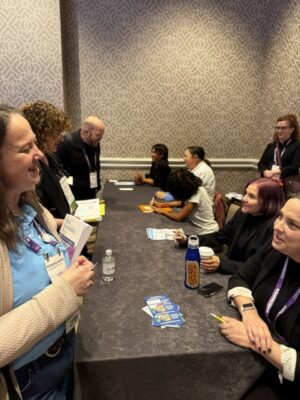
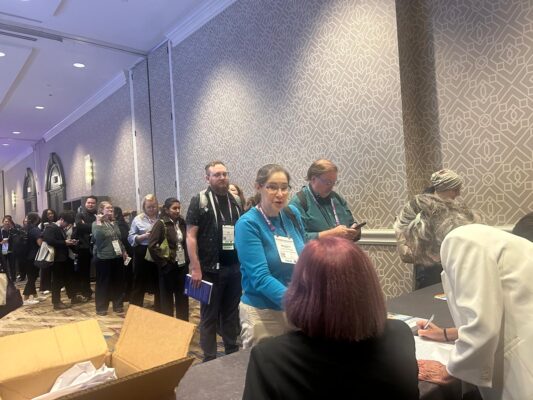
Right after this talk M-Enabling organizers made a table available in the exhibit hall for participants to purchase books and have them signed by the authors who were at the Summit. The image at the top of this post is the line of people waiting to purchase books. The two images below show smiling readers with their books open to the page where authors signed and the long table where authors signed.
Gratitude to the M-Enabling Summit, the organizers, and the team that made this book signing so fun!

Notes
Here are some resources and other notes about what I said during my M-Enabling Summit 2026 Lightening Talk
- Senator Harkin’s letter and the DOJ response are in this document in the Department of Justice archives.
- I wrote about The Harkins<>DOJ correspondence in #ADA32: The ADA has applied to digital for decades on this website, my article celebrating the 32d anniversary of the passage of the law.
- Visit the Global Law and Policy page on this website for information about other countries with accessibility laws, policies, and standards. This page relies on the community. Please send Updates, mistakes, and new laws through the Contact Page of this website.
- Read the full text of the UN Convention on the Rights of Persons with Disabilities on the website of the United Nations here.
- The UNCRPD is also discussed on the United Nations Treaty section of the LFLegal Global Law and Policy page of this website.