Articles
This page has short summaries of every article posted on Lainey Feingold's website with links to the full articles. Visit the Topics Page for all 300 plus articles on this website organized into 38 topics including Structured Negotiation and digital accessibility.
The articles here are in chronological order, arranged by the date of publication or the date of the most recent Update when an article has been updated. Most recent articles and updated articles appear first on this list.
When an Article is updated there is a link to the Updates right below the the summary of the page.
On August 17, 2021 judges in the 11th Circuit Court of Appeals upheld sanctions against a Florida lawyer (Scott Dinin) and his client (Alexander Johnson) because of unethical conduct in cases brought under the Americans with Disabilities Act (ADA) and similar Florida law. Sanctions are a way that a court can punish lawyers and clients for bad behavior. In this case the sanctions included requiring Johnson and Dinin to pay money to a disability-based nonprofit or the court and preventing them from filing ADA cases without the court’s permission.
Read more… U.S. Federal Appeals Court Slams Unethical ADA Practice
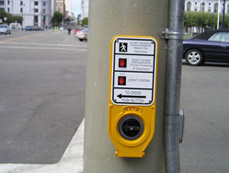
The Settlement Agreement about Accessible Pedestrian Signals with the City and County of San Francisco was the first in the country to address this critical pedestrian safety issue. The agreement, in which the City agreed to spend at least 1.6 million dollars and install APS at at least 80 intersections, was negotiated by Lainey and co-counsel Linda Dardarian using Structured Negotiations. Claimants in the case were the California Council of the Blind, the San Francisco based LightHouse for the Blind and Visually Impaired, the Independent Living Resource Center San Francisco, and blind advocate Damien Pickering. As exhibits to the Settlement Agreement, the parties negotiated Technical Specifications and a detailed tool to help public entities prioritize intersections for APS installation. Contact us if you would like a copy of the tool.
Read more… San Francisco APS Agreement
The United States Access Board is currently considering proposed changes to the ADA Accessibility Guidelines (ADAAG) that would require certain self-service kiosks to be accessible to people with disabilities. Based on their experience with Talking ATMs and tactile point of sale devices, the Law Office of Lainey Feingold and Linda Dardarian of Goldstein, Demchak, Baller, Borgen & Dardarian, prepared comments on the Board’s proposal for use by persons interested in accessible devices. Those comments, all or parts of which were incorporated into submissions filed with the Board by several organizations, are posted here.
Read more… Access Board Considers ADAAG Coverage for Self-Service Kiosks
The press release posted here extends the Agreement between Major League Baseball and the American Council of the Blind and its Massachusetts and California affiliates. This is the first agreement of its kind to address the accessibility of applications for mobile devices. MLB has agreed to use the Web Content Accessibility Guidelines (WCAG) 2.0 Level AA as its standard for mobile applications, and has recently released AtBat™ for the iPhone and iPad with enhanced accessibility.
Read more… MLB Continues Accessibility Initiative with AtBat™ App for iPhone and iPad
I opened my law office in the upstairs bedroom of my house on October 1, 1996, 25 years ago this Fall. It’s been a quarter century of practicing law in the digital accessibility space. And a quarter century of practicing law with what I now call dolphin skills (thus the image of jumping dolphins illustrating…
Read more… LFLegal at 25
In June, 2007, the following article by reporter Tim Hay was published in the legal newspaper San Francisco Daily Journal.
Read more… Daily Journal Article about Structured Negotiations
The United States Access Board has announced that it will (finally) publish proposed Public Rights-of-Way Guidelines on July 26 – the 21st anniversary of the Americans with Disabilities Act. The guidelines will address access to sidewalks and streets by people with disabilities, including accessible pedestrian signals, crosswalks, roundabouts, curb ramps, street furnishings, parking, and other components of public rights-of-way. Technical specifications on these issues will be welcomed, but it is important to remember that the Americans with Disabilities Act has required such access for more than twenty years.
Read more… Proposed Public Rights-of-Way Guidelines (Finally) Coming July 26
On April 7 the 11th Circuit Court of Appeals issued an Opinion in a web accessibility lawsuit against the Winn-Dixie grocery chain. As a disability rights lawyer who has worked in the digital accessibility legal space for more than a quarter of a century, I was dismayed with the Opinion. It held that the Americans…
Read more… Winn-Dixie Opinion: a Judge On a Mission to Eliminate Civil Rights
[APRIL 3, 2021 UPDATE] On February 12, 2021, the (so-called) Online Accessibility Act was re-introduced in the United States Congress. This proposed piece of legislation is identical to the bill introduced last year and has all the problems of last year’s bill described in the article here.
Read more… In 2021 The Proposed Online Accessibility Act in US Congress is [STILL] Bad for Digital Inclusion
The article posted here by Lainey Feingold first appeared in the July 2017 issue of Just Resolution E-News, a publication of the Dispute Resolution Section of the American Bar Association. It tells of the significant similarities between Structured Negotiation and Collaborative Law, two dispute resolution methods focused on cost-effective problem solving without litigation. Structured Negotiation:…
Read more… First Cousins: Structured Negotiation and Collaborative Law



![In 2021 The Proposed Online Accessibility Act in US Congress is [STILL] Bad for Digital Inclusion](https://www.lflegal.com/wp-content/uploads/2020/10/legislationdownload.jpeg)