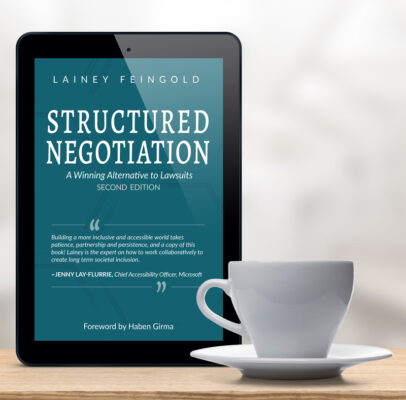
Four years after I published the second edition of my book — Structured Negotiation, a Winning Alternative to Lawsuits– something unexpected happened that brought me great joy. An Australian peacemaker named Andrew Wood carefully read the book and wrote a blog post about every chapter. Every one!
They are published on LinkedIn and on his Substack called Field Notes from Post-Law Peacemaking. I encourage anyone interested in collaborative problem solving to read them.
Andrew uses the term “peacemaker” to describe his work as “Post-Lawyer | Mediator & Negotiation Facilitator | Collaborative Dispute Resolution Specialist. Each of his articles analyzes a particular Structured Negotiation chapter and how it relates to his work designing Australia’s Veterans’ Alternative Dispute Resolution (ADR) Program, work done through his organization Work Accord.
I love that Andrew grapples with how to apply a process born at the intersection of disability and accessibility 7,000 miles from his home to the entirely different context of veterans disputes in Australia. As I read Andrew Wood’s detailed chapter reviews I found myself saying over and over “Yes! That’s exactly what I meant. That’s what’s important.”
Jump to:
share on linkedinshare on bluesky
From Digital Accessibility in the US to Veterans Disputes in Australia
Hearing from a reader who’s read my book is always great. Andrew’s writing about the book goes beyond what anyone else has done since the book was first published in 2016, updated in 2021. He digs deep to understand what I was trying to say when I decided to share Structured Negotiation’s stories and strategies from over a quarter century of using the method to advance digital accessibility in the United States.
With deep gratitude I share here his thoughts from just four of the 17 chapters he reviewed and wrote about.
Andrew Wood on Chapter 2 — The Language of Structured Negotiation
The [ Structured Negotiation] approach places story or narrative – not argument – at the centre of the project. Lainey Feingold is not just asking us to reword our letters. She is asking us to reshape our inner posture – to speak (and write) in ways that disarm defensiveness, refuse combat metaphors, and create space for understanding. Structured Negotiation invites us to reorient – to speak, not from reflex or rhetoric, but from care, clarity, and relationship. That shift matters. Especially here.Reading Structured Negotiation Chapter 2
“Especially here” is Andrew’s work with veterans. He believes that Structured Negotiation aligns with that work because “if ever there was a context in which combat language might prevail and shape outcomes, it would be the veterans’ ADR context, where that language is deeply ingrained through training and service.”
For close to thirty years in the digital accessibility space, I’ve found that combat language is also deeply ingrained in the US legal system. And that this language does not serve efforts to advance disability inclusion in tech.
Andrew Wood on Chapter 3 — Is Structured Negotiation the right choice?
Citing the Walmart negotiation, which resulted in the accessibility upgrade of 10,000 Point-of-Sale devices, she writes:
The Walmart POS settlement did not produce judicial precedent binding in future cases. Structured Negotiation never does. But lawyers and clients who shy away from the method for that reason ignore a different type of precedent. Working with large institutions outside the courthouse I have seen repeatedly that industry precedent is real and motivating. Industry precedent gives companies permission to act after a few leaders make the first move.
It is worth focusing on that expression, “permission to act.” Structured Negotiation done well can create safe commercial space for moral courage – or as Feingold puts it – to do the right thing.Reading Structured Negotiation Chapter 3
Almost ten years after I first wrote those words, I still believe in the power of industry precedent in the digital accessibility space. Over the years it has moved the needle in my work on talking prescription labels, talking ATMs, accessible mobile applications and other technology.
Court cases can do that too, which is why I almost never talk about Structured Negotiation without also highlighting the importance of ethical lawsuits as a tool to advance digital accessibility.
Andrew Wood on Chapter 8 — Experts in lawsuits vs. Structured Negotiation
In many traditional legal processes, “expert” is almost synonymous with “weapon.” You’ve likely heard the phrase, “a battle of experts.” One side brings theirs, the other side brings theirs, and both try to outgun each other in court…..But in Structured Negotiation, experts are not deployed to dominate they are engaged to teach.
This Field Note explores how Structured Negotiation repositions expertise as a shared learning resource, and what that shift requires from us – especially those of us trained in adversarial or hierarchical systems of knowledge.Reading Structured Negotiation Chapter 8
I’m glad Andrew highlighted the role of experts in Structured Negotiation. It is a key reason why the process is so much less expensive than contested litigation. Money is far better spent building sustainable accessibility programs than in paying experts to fight with each other.
There is another value to Structured Negotiation’s approach to expertise. As I describe in the book, the strategy also creates essential space for disabled advocates (who would be limited to the “plaintiff” role in litigation) to share their expertise. One example of many are the blind advocates that came together in a Structured Negotiation with San Francisco that lead to accessible pedestrian signals. Not only did they have lived experience of navigating dangerous city streets without audible signals, one was getting an advanced degree on accessible signals and one served on state pedestrian safety committees.
In that and many other cases, expertise of people with disabilities has been crucial to advancing accessibility with this strategy.
Andrew Wood on Chapter 16 – the Structured Negotiation mindset
Feingold lists the qualities that make up [the Structured Negotiation] mindset: patience, trust and optimism; confidence and equanimity; appreciation, careful listening, friendliness, and empathy. These are presented as practical tools that keep negotiations moving when there is no judge to issue directions and no adversarial machinery to keep the pressure on.
Reading this chapter in October 2025, I am struck by how countercultural these virtues now seem. In public discourse dominated by hostility and noise, where empathy is derided as weakness, patience as dithering, and kindness as naïveté, Feingold’s invitation to practise them feels like a call to resistance. Her mindset resists determinism and fatalism. It insists on the possibility of collaboration, the necessity of hope, and the courage of care. And I am convinced that it is more needed than ever.Reading Structured Negotiation Chapter 16
The Structured Negotiation mindset has probably been the most important element of this process. And it works when taking a collaborative approach to advancing accessibility outside the litigation system too. All accessibility advocates negotiate, and the mindset can help.
I often refer to the qualities of the Structured Negotiation mindset as “dolphin qualities” — a metaphor Andrew recognized in this image he used at the top of each of his chapter reviews. He uses the caption “a small pod of wild dolphins swimming in calm waters.” 
“Be a dolphin not a shark” is a mantra that has worked well for me in advancing accessibility for decades.
(For more on dolphins and Structured Negotiation read “Why A Dolphin” on this website, which, among other things, shares the Australian version of TV’s dolphin Flipper – a collaborative kangaroo named Skippy. You can find a talk I did at the 2024 Paris Web Conference titled “Be a Dolphin not a Shark: Using cooperation over conflict to advance digital accessibility” here.)
What’s next for Structured Negotiation
In his last chapter review (Chapter 17) Andrew writes: “Structured Negotiation is not a niche experiment, but a tested method with real-world results that are attracting real-world attention and support. But where might we go from here?”
“With a little imagination,” he says, “Structured Negotiation could also be deployed in resolving data and privacy breaches; consumer and product safety claims,” and several other types of disputes he identifies.
The full potential of Structured Negotiation is up to you. I encourage readers to dip into all of Andrew’s beautiful writings and think about whether the Structured Negotiation strategies can help in your work. (As I write in the second edition, Structured Negotiation is not just for lawyers; the strategies have potential in all types of advocacy situations.)
The book is available in both English and Spanish, both paperback and digital. More about the book on the Structured Negotiation page of this website, but honestly, everything you may want to know about the book is covered in Andrew Wood’s series. Find each article here: