Big Win for Web Accessibility in Domino’s Pizza Case

[UPDATE: On October 7, 2019 the United States Supreme Court announced it would not hear, would not rule on, the Domino’s case. On June 13, 2019 Domino’s asked the United States Supreme Court to hear this case and reverse this decision. Read the October 7, 2019 post on this website about the Supreme Court’s announcement.]… Read more… Big Win for Web Accessibility in Domino’s Pizza Case

U.S. Supreme Court Won’t Hear The Domino’s Case (Hooray!)

Great news for advocates of digital inclusion for people with disabilities! Today the United States Supreme Court rejected Domino’s Pizza’s efforts to overturn the Ninth Circuit federal appeals court opinion in the Domino’s web and mobile accessibility case. That appeals court opinion said that disabled people can bring claims under the Americans with Disabilities Act if a website or mobile application is not accessible. Read more… U.S. Supreme Court Won’t Hear The Domino’s Case (Hooray!)

Big Win for Blind Shopper in First U.S. ADA Web Accessibility Trial

[UPDATE: The Winn-Dixie case is currently on appeal to the 11th Circuit Court of Appeal] On June 13, a judge in the federal District Court in South Florida made history. That history came in the form of a court order in a lawsuit filed by blind Florida resident Juan Carlos Gil against regional grocer Winn-Dixie.… Read more… Big Win for Blind Shopper in First U.S. ADA Web Accessibility Trial

Companies are Losing Web Cases: Spend Money on Web Access, not Lawyers

In less than two months, four different federal judges have said “Yes” to website accessibility. These cases, from Florida and New York, are a wake-up call to every business in the United States that serves the public: If you have a website, make it accessible so everyone can use it, including disabled people. Every business has a budget; every business watches how money is spent. These cases are but the most recent in a long-string of wake-up calls with a simple message: Spend your hard-earned dollars on accessibility, not on lawyers to fight it. Read more… Companies are Losing Web Cases: Spend Money on Web Access, not Lawyers

Accessibility Culture

Digital accessibility means disabled people can use and interact with technology and digital content.  It is about good design, development, and coding; appropriate testing and training; an inclusive workforce, and a host of other details. It’s an ongoing commitment to including all users in all technology. Mistakes and back sliding are less likely with a culture of accessibility. Read more… Accessibility Culture

More than Mickey: Digital Accessibility Law in Anaheim, March 2019

Anaheim California is best known as the home of Disneyland, that place of childhood wonder and crass commercialism. In March 2019 Anaheim will be the site of something else: Lots of learning and conversation about the digital accessibility legal space. On March 12 Lainey will be speaking at the first ever Digital Accessibility Legal Summit.… Read more… More than Mickey: Digital Accessibility Law in Anaheim, March 2019

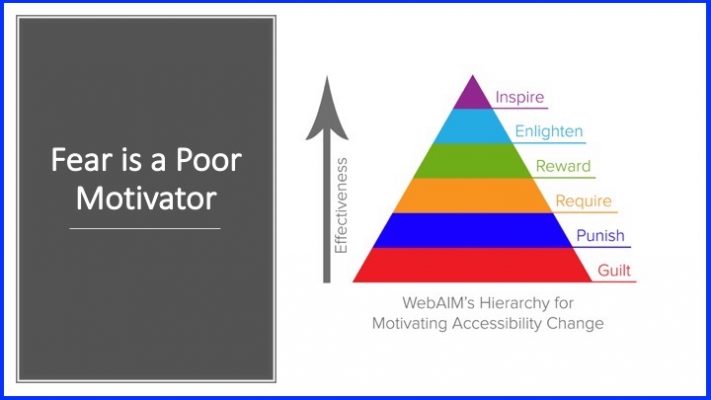
Fear is a Poor Motivator for Accessibility

For a recent keynote delivered at the third annual ICT  Accessibility Testing Symposium I included the slide pictured with this post.  If social media is any indication, it was far and away the most popular slide in my talk. The slide image was developed by Jared Smith  of the accessibility consultancy WebAIM and is titled “WebAIM’s Hierarchy… Read more… Fear is a Poor Motivator for Accessibility

First Accessibility Agreement in U.S. to Use WCAG 2.1: Reached With Structured Negotiation (Alameda County accessible voting case)

On November 2, 2018 Alameda County California, three blind residents, and the National Federation of the Blind announced a settlement designed to protect the rights of blind voters to participate fully in the county’s voting program. It is the first agreement in the United States to include WCAG 2.1 as the accessibility standard. The parties used Structured… Read more… First Accessibility Agreement in U.S. to Use WCAG 2.1: Reached With Structured Negotiation (Alameda County accessible voting case)

E*Trade Digital Accessibility Settlement Agreement

The settlement agreement posted here details E*Trade’s commitment to improving the accessibility and usability of its website, mobile application and online trading platform for customers who are blind. The agreement was reached in Structured Negotiation; no lawsuit was needed or filed. The Law Office of Lainey Feingold and Linda Dardarian, of the Oakland civil rights firm Goldstein, Borgen, Dardarian and Ho represented Pratik Patel and Victor Tsaran, two E*Trade customers, in the negotiation. E*Trade will be using the Web Content Accessibility Guidelines 2.0, Level AA as its accessibility standard. The agreement identifies the International Standards Organization (ISO) 14289, also known as PDF/UA (PDF/Universal Accessibility) standard as the standard for PDF accessibility. Read more… E*Trade Digital Accessibility Settlement Agreement