Companies are Losing Web Cases: Spend Money on Web Access, not Lawyers

In less than two months, four different federal judges have said “Yes” to website accessibility. These cases, from Florida and New York, are a wake-up call to every business in the United States that serves the public: If you have a website, make it accessible so everyone can use it, including disabled people. Every business has a budget; every business watches how money is spent. These cases are but the most recent in a long-string of wake-up calls with a simple message: Spend your hard-earned dollars on accessibility, not on lawyers to fight it. Read more… Companies are Losing Web Cases: Spend Money on Web Access, not Lawyers

More than Mickey: Digital Accessibility Law in Anaheim, March 2019

Anaheim California is best known as the home of Disneyland, that place of childhood wonder and crass commercialism. In March 2019 Anaheim will be the site of something else: Lots of learning and conversation about the digital accessibility legal space. On March 12 Lainey will be speaking at the first ever Digital Accessibility Legal Summit.… Read more… More than Mickey: Digital Accessibility Law in Anaheim, March 2019

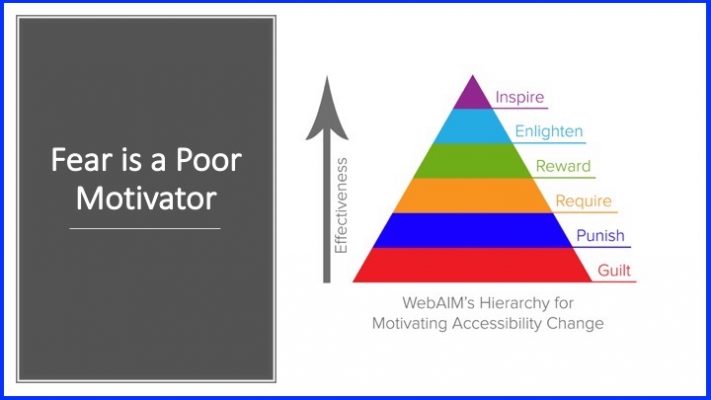
Fear is a Poor Motivator for Accessibility

For a recent keynote delivered at the third annual ICT  Accessibility Testing Symposium I included the slide pictured with this post.  If social media is any indication, it was far and away the most popular slide in my talk. The slide image was developed by Jared Smith  of the accessibility consultancy WebAIM and is titled “WebAIM’s Hierarchy… Read more… Fear is a Poor Motivator for Accessibility

First Accessibility Agreement in U.S. to Use WCAG 2.1: Reached With Structured Negotiation (Alameda County accessible voting case)

On November 2, 2018 Alameda County California, three blind residents, and the National Federation of the Blind announced a settlement designed to protect the rights of blind voters to participate fully in the county’s voting program. It is the first agreement in the United States to include WCAG 2.1 as the accessibility standard. The parties used Structured… Read more… First Accessibility Agreement in U.S. to Use WCAG 2.1: Reached With Structured Negotiation (Alameda County accessible voting case)

Asking about compliance? You may be asking the wrong question

During a recent presentation about the digital accessibility legal space I was asked a question. It was about a word that pops up with increasing frequency as fear of lawsuits drives too much of the digital accessibility world. The “C” word — compliance. The question was this: If the captions on online videos are 65% accurate do you think that would comply with legal responsibilities?audience question This is the kind of question that arises when people are driven by fear. When people forget what accessibility is about. Even forget what the law is about. Read more… Asking about compliance? You may be asking the wrong question

Fall 2015 Update: More Delay for DOJ Web Regulations

Every six months, agencies in the United States federal government must notify the public about the status of pending regulations. On November 19, 2015, The U.S. Department of Justice (DOJ) gave an update about pending regulations regarding the accessibility of websites. As the agency has done many times before, the update boils down to a five letter word: Delay. Read more… Fall 2015 Update: More Delay for DOJ Web Regulations

Web Accessibility for Grocers: Winn-Dixie Wasn’t Paying Attention

Last month the Winn-Dixie grocery chain lost the very first trial under the Americans with Disabilities Act about the accessibility of a private company’s website. A blind shopper had sued the chain when he couldn’t access online coupons and other parts of the company’s website. The judge’s verdict was big news; unlike most accessibility stories it was covered in the mainstream media. But web accessibility for grocery stores is nothing new. If Winn-Dixie had been paying attention, it would have known over three years ago that grocery chains were making their websites accessible. Winn-Dixie should not have waited for the legal knock on the door. When it came, it should not have put up a fight. Read more… Web Accessibility for Grocers: Winn-Dixie Wasn’t Paying Attention

Digital Accessibility Legal Update (CSUN 2015)

This post is a version of the presentation Lainey Feingold gave in March 2015 at CSUN – the International Technology and People with Disabilities conference held annually in San Diego, California and sponsored by California State University Northridge (CSUN). The presentation covered legal developments in digital accessibility since CSUN14 (March 2014 through March 7, 2015). Read more… Digital Accessibility Legal Update (CSUN 2015)