Articles
This page has short summaries of every article posted on Lainey Feingold's website with links to the full articles. Visit the Topics Page for all 300 plus articles on this website organized into 38 topics including Structured Negotiation and digital accessibility.
The articles here are in chronological order, arranged by the date of publication or the date of the most recent Update when an article has been updated. Most recent articles and updated articles appear first on this list.
When an Article is updated there is a link to the Updates right below the the summary of the page.
[quote from=”Ninth Circuit Opinion in State of Arizona v. Harkins”]We disagree with Harkins that captioning and descriptive narration fall outside the ADA as a matter of law. As stated previously Plaintiffs are seeking an auxiliary aid, which is specifically mandated by the ADA to prevent discrimination of the disabled.[/quote]Great news for visually impaired movie goers! On April 30, 2010 the Ninth Circuit Court of Appeals in San Francisco ruled that audio description is “clearly” an “auxiliary aid and service” under the Americans with Disabilities Act. This ruling revives an Arizona lawsuit against the Harkins movie theater chain that had been thrown out of court in 2008.
The plaintiffs can now continue their case against the Harkins chain for the company’s failure to provide audio description at its theaters. The case can also go forward on claims brought by deaf and hearing impaired theater-goers for captioning.
Read more… Federal Appeals Court Victory for Blind Movie Goers
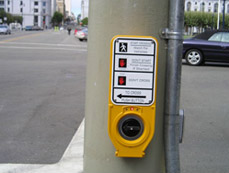
SFMTA Expands APS Program
Accessible Pedestrian Signal Program Receives Stimulus Funds
San Francisco (March 24, 2010)–The San Francisco Municipal Transportation Agency (SFMTA), which oversees all surface transportation in San Francisco including the Municipal Railway (Muni), today announced that the City has received federal stimulus funds that will equip five additional intersections with Accessible Pedestrian Signals (APS). In the City 116 intersections have been equipped with the devices over the past two and a half years, making San Francisco the national leader on this important safety issue.
Read more… San Francisco – National Leader in Installing Accessible Pedestrian Signals
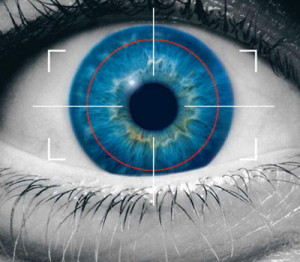
On March 15, 2010 CNN posted an article about the use of iris scanners in a low income Bronx health clinic to prevent mix-ups among the patients. The high tech iris scanner, usually seen only in airport security systems, is an important and useful tool for the Bronx clinic, and a welcomed one in an under-served community. At the same time, this article is yet another reminder that technology advances in the health field have the potential to leave people with disabilities behind. If you don’t have an iris, an iris scanner cannot help you.
Read more… Iris Scanner Protects Medical Records – But What if You Don’t Have an Iris?
Web more accessible to those with disabilities
(article appearing on page 1 of the San Francisco Chronicle on January 1, 2010, by staff writer Alejandro Martínez-Cabrera)
San Francisco, CA (January 1, 2010)– During her high school years, Lisamaria Martinez, who has been visually impaired since she was 5, carried a 25-pound backpack to school crammed with books written in Braille.
But once she was introduced to the Web at UC Berkeley, she started getting professors’ class notes by e-mail, using text-to-speech software, and trading heavy Braille tomes for a few words and a click on a search engine.
Read more… Web Accessibility Press Coverage on New Year’s Day
The Law Office of Lainey Feingold is pleased to announce that The Civil Rights Litigation Clearinghouse is now posting settlement agreements reached using Structured Negotiations. The Clearinghouse web site is a collection of documents and information about civil rights cases from across the United States organized in selected case categories. Its goal is to allow “greater understanding” of the importance of civil rights litigation in this country.
Read more… Civil Rights Clearinghouse Includes Structured Negotiations Settlements
In August of this year, blind advocates in Pakistan demanded an end to widespread discrimination against blind people by the banking industry in that country. Their advocacy has paid off. In early December 2009, the Islamabad-based International News and The Nation published articles, posted here, with the headlines “Banks directed to permit blind people to open accounts” and “Ministry to install ATMs for visually impaired.” The articles report that all banks in Pakistan will now be required to allow blind citizens to open their own bank accounts and will issue information in Braille to facilitate banking independence. And, for the first time, Talking ATMs are being planned for installation in Islamabad. Efforts to end discrimination in Pakistan against people with disabilities in insurance and micro-lending are also underway.
Read more… Pakistan ATM Advocacy: Blind Community Success
Structured Negotiations were not the only legal strategy used by blind advocates interested in expanding Talking ATM installations in the United States. In this post you can read about successful Talking ATM litigation that increased the numbers of Talking ATMs in the United States. Litigation also played another role in the history of Talking ATMs. On at least two occasions, the blind community was forced to object to class action settlements that did not fairly address the issue of accessible ATMs. Read about objections to class action settlements that threatened Talking ATM advocacy.
Read more… Talking ATM History: Litigation Plays a Role
The Trader Joe’s Point of Sale Agreement posted here was negotiated by Lainey and Linda Dardarian using Structured Negotiations on behalf of the American Council of the Blind, the American Foundation for the Blind and the California Council of the Blind. In the Agreement, Trader Joe’s agreed to install tactile point of sale devices at all its stores in the United States.
Read more… Trader Joe’s Point of Sale Agreement and Amendment
In October, 1999, the first Talking ATM was installed in the United States. Ten years later, advocates around the world continue to push for equal and confidential access to financial information and technology. The following article appeared on August 6, 2009 in The International News, published in Islamabad, Pakistan. It is about a protest organized by blind activists in that city to protest banks’ refusal to issue ATM cards to blind consumers.
Read more… Blind Advocates in Islamabad, Pakistan Demand ATM Access
A group of disability rights lawyers and advocates has announced the creation of The Barrier Free Healthcare Initiative, a collaborative effort to support legal and policy initiatives aimed at eliminating the physical and programmatic barriers that people with disabilities face in obtaining healthcare. More information is available at the new website launched by the initiative. The initiative was launched to coincide with the announcement of a landmark settlement with two
Read more… The Barrier Free Healthcare Initiative Launched