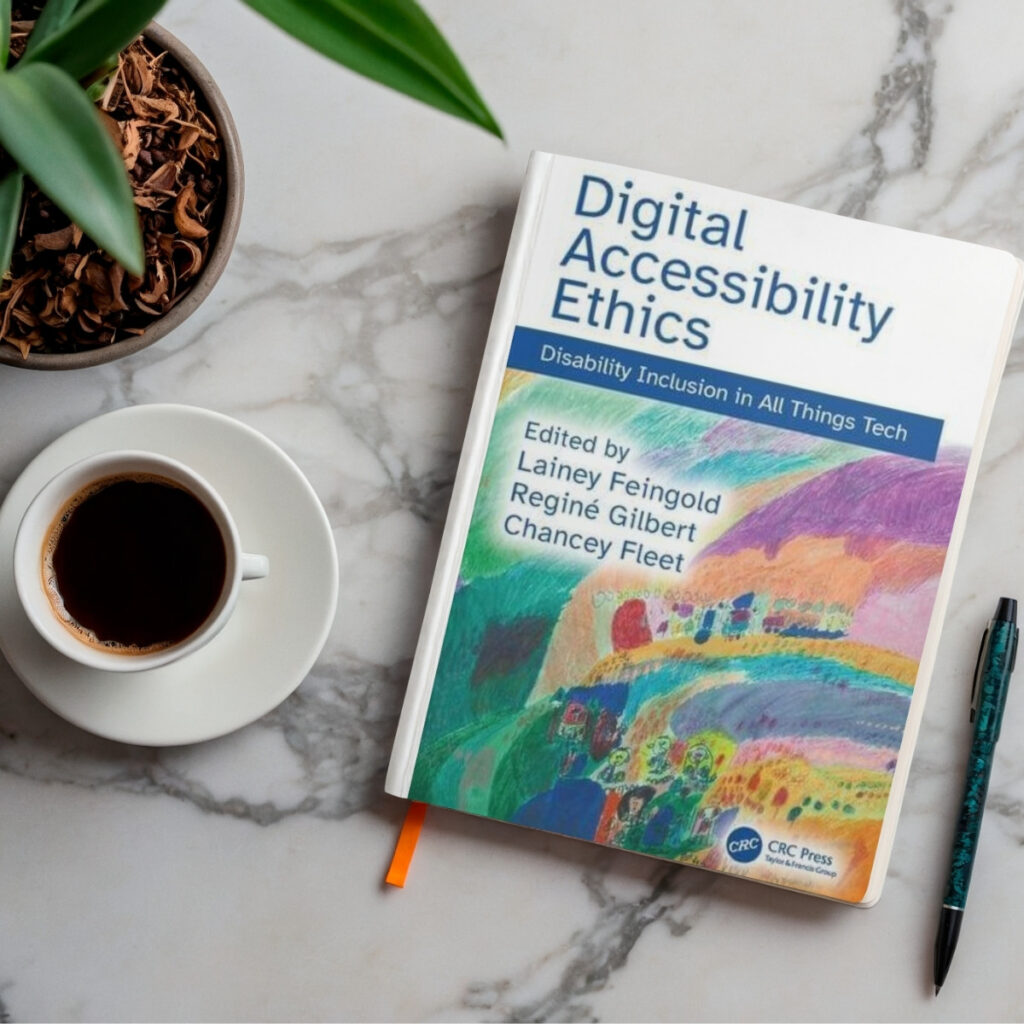
Announcing Digital Accessibility Ethics Disability Inclusion in All Things Tech Edited by Lainey Feingold, Reginé Gilbert, Chancey Fleet
Ethics Book Editors and Authors
39 authors contributed to Digital Accessibility Ethics: Disability Inclusion in All Things Tech, including the book’s three editors. We come from 10 countries and 1 commonwealth. We are disabled and non-disabled. Together, we have over 600 years of experience in digital accessibility and disability advocacy.
What a collaboration of greatness!
Holy cow that’s an all-star contributing authors list if I’ve ever seen one!
This contributor/author list is like the Avengers of accessibility and tech super heroes.
Table of Contents
The Digital Accessibility Ethics book begins with an Introduction titled The Digital Accessibility Gap and the Need for an Ethics Framework. Three sections follow:
- Section One (Foundation)
- Section Two (Ethical Accessibility Practices)
- Section Three (Digital Accessibility Belongs in Ethics Across Sectors)
Chapters in each Section explore and apply the Digital Accessibility Ethics Framework through stories, strategies, best practices, and other guidance.
The book’s Conclusion asks What’s Next for Digital Accessibility Ethics? It offers practical suggestions for implementing and growing the Digital Accessibility Ethics Framework.
Find a list of all chapters in each Section on the Ethics Book Table of Content Page on this website.
Praise for Digital Accessibility Ethics
… a timely, much needed ethical framework that moves beyond narrow legal and cost-benefit approaches. An important read for all!
….Most exciting, this groundbreaking collection offers a novel and actionable ethics framework – a roadmap for tech accessibility which benefits us all.
… a masterclass in digital accessibility offering a pioneering Digital Accessibility Ethics Framework. A must-read for anyone who is involved in the design, procurement, or use of digital technologies — ie, everyone.
Invite Lainey to Speak
Lainey gave her first talk about digital accessibility ethics at the Accessibility Toronto conference (#A11yTO) in 2019, six years before the 2026 publication date of Digital Accessibility Ethics: Disability Inclusion in All Things Tech.
Learn more about Lainey as a speaker and trainer on the Speaking page of this website.
Summary
This page has information about a new book called Digital Accessibility Ethics: Disability Inclusion in All Things Tech. Lainey Feingold is one of three editors of the book. She also wrote two chapters. There are 32 chapters in the book written by authors from 10 different countries. Some are disabled and some do not have a disability. You can find a link to information about all authors on this page.
The book talks about why digital accessibility must be part of everyone’s ethics. Two disabled doctors, for example, wrote a chapter on their need for accessibility both as doctors and patients. You can find a link to the table of contents listing all chapters on this page.
The book introduces the Digital Accessibility Ethics Framework. It has values, actions, and questions. And it can help organizations stop excluding disabled people when they design technology. It can also help avoid risks and harms when disabled people are excluded.